Tuesday, June 6, 2017

cost inflation index table for india

Indexation of cost is useful in case of capital gains that arise from debt funds or sale or property assets held beyond a period of 3 years. This enables individuals to calculate gains after adjusting the cost for inflation, which typically will reduce the amount of taxable gains.

Govt. has recently released cost inflation index table for India.

2001-02
100
2002-03
105
2003-04
109
2004-05
 113
2005-06
 117
2006-07
122
2007-08
129
2008-09
 137
2009-10
148
2010-11
167
2011-12
184
2012-13
200
2013-14
 220
2014-15
240
2015-16
254
2016-17
264
2017-18
272

fixed deposits or debt funds?

Fixed deposits or debt funds? Well, that's a question that I have heard quite a few times in recent days. They are different instruments and neither fixed deposits or debt funds can be completely ignored. Hence, you need to understand when to use what and the risk associated with them. 

Fixed deposits are the deposits done with financial institutions like banks against a fixed rate of return for a fixed period of time. And this is mostly considered risk free, although it's not, and can be broken easily these days via net banking and hence quite liquid as well. Why I say fixed deposits are not risk free - if your bank goes bankrupt, then irrespective of how many crores bank owes to you, you would only be entitled for a lakh or two. 

Debt funds are the mutual funds that invest debt instruments like bonds, debentures, government loans, structured loans etc. Read more on the details of types of debt funds.  

Below is a quick comparison of both the products 


Fixed Deposits
Debt Funds
Rate of return
Gives you a fixed rate of return irrespective of market conditions
Gives you a rate of return which is typically higher than that of corresponding fixed deposit for similar tenure as the redemption period.
Associated Risk
Fixed deposits are considered risk free.
Since these invest in market debt instruments, they are considered riskier than the fixed deposits. The longer the tenure of the bonds the fund is investing in the higher the associated risk and higher the potential return
Liquidity
Fixed deposits now a days can be closed online. And many banks provide you instant credit of the proceeds - however the rate of interest applied would be for the period FD is held and some amount deducted as penalty for pre-mature closure
Liquid funds now a days provide you an instant credit option.
All other funds would credit you the proceeds within a matter of 2-3 working days. Also, note that some debt funds have exit load as well if held below a given period.
The units are redeemed at market NAV
Part Redemption
Some banks do offer fixed deposits with swipe out facility. Which means while withdrawal, only the amount short in your savings account would be pulled out from your fixed deposit. However, not all FDs are of this nature and can only be redeemed in full.
Debt funds allow you to put in and pull out as much money as you want and whenever you want.
TDS
Banks deduct 10% TDS from the fixed deposits every year and that is submitted to government.
Hence, if you keep the money in FD for three years, every year you have TDS deducted from the interest accrued
There is no TDS deducted from mutual funds, the whole interest earned stays with you till the time you really go for redemption of the units.
Hence, tax is deferred till redemption
Tax Treatment
Interest earned on Fixed deposits is simply added to your income and taxed based on your tax slabs. This is irrespective of the number of years you hold the fixed deposits.
Income from debt funds i.e. redemption value - invested value for the given units is short term gain if redeemed before 3 years else it is capital gain.
Short term gains are added to your income and taxed based on your tax slabs.
Capital gains are calculated with indexation benefit, and taxed at 20% irrespective of your tax slabs.

I beleive above comparison is good enough to help you make right decision to choose your vehicle of investments. 

Monday, May 29, 2017

Debt and hybrid funds

Debt and hybrid funds
I have met few people recently who are aware of mutual funds and have been investing in them for quite some time, however it was surprising for me that they equate mutual funds to directly equity funds. They were not aware of the debt funds at all, leave apart the different categories of these funds and how they can leverage them.

Well this prompted me to pen down some basics on the debt and hybrid funds

What are debt funds?

Debt funds are basically mutual funds which invests full or part of their corpus in debt instruments like company bonds, govt bonds, loans to state governments, structured debts, debenture said etc. These instruments are rated by credit agencies (AAA and A1 ratings considered safer).

These instruments are slightly riskier than your fixed deposits and hence the institutions offering them compensate this risk by offering higher return. These instruments vary on maturity, the nearer the bond to its maturity the lower the risk and lower the premium. And hence, funds investing in bonds of longer maturity typically generate more returns than the ones investing in shorter maturity bonds.

Debt funds provide you an opportunity to earn more than your bank fixed deposits with tax benefits. From the tax benefit perspective just remember - for investment in debt funds for over 3 years your income is taxed @20% with indexation benefits.

Like equity funds there are both open ended and close ended funds. Most of the debt funds are open ended, however there are close ended funds typically called Fixed Maturity plans. They can only be subscribed during NFO's and can only be redeemed on maturity. FMPs are a very good alternative to fixed deposits in banks.

Debt funds on basis of debt maturity period

This classification is based on the maturity period of the debt instruments. It has nothing to do with how long you are holding the fund. 

Liquid Funds
Upto 91 days
Ultrashort term funds
Typically 91 days to 18 months
Short term funds
Typically 12 months to 36 months, sometimes even more
Income Funds
Really Flexible, 1 year to even 15-20 years

 Apart from this there are special funds that only invest in securities issued by central or state governments or provide loans to govt. These are called Gilt funds, Unlike bonds issued by companies, the chance of the Government defaulting on its loan obligation is significantly lower. 

Now, a combination of maturity and gilt nature provide the following options 
  • Short term gilt funds 
  • Medium-long term gilt funds 
All, the fund types mentioned above are the ones that only invest in debt instruments with no component of equities at all. 

Debt funds with mix of equity (Hybrid Funds)

These are basically funds that are classified as debt funds as they have major portion of their corpus invested in debt instruments and less in equity. Their tax treatment is same as that of any other debt fund. 

The classification here is based on the amount of corpus investible in debt and equities. 
  
Conservative Debt Funds
Upto 10% equity and rest in debt
Moderate Debt Funds
Upto 20% equity and rest in debt
Aggressive Debt Funds
Upto 30% equity and rest in debt
Equity oriented Debt funds
More than 65% in equity rest in debt

Now, since equity oriented debt funds have more than 65% in equity the tax treatment of them is same as that of equity funds. This is a very important factor to keep in mind while working with these funds. 

Asset allocation funds

These are special funds, where an investor does not need to bother about how much to put in equity and how much in debt. These funds makes the asset allocation decision between equity and debt based on the fund manager's view of the market direction and try to optimize the returns for the end investor. 

They are also called fund of funds and invest in other debt or equity funds. Note that due to this nature of these funds, they have a double incidence of expense ratio on your investments - one at the actual fund level and another at the asset allocation fund level. 

Arbitrage funds 

These funds aim to capture arbitrage opportunities in the cash and derivative market and invest some portion in the debt segment. In layman terms, since the market can never be in synch on the prices of the same stock at two different places - they take advantage of this difference. For instance, it's like you buy an item at flipkart on discount and sell the same on amazon at MRP, the delta/arbitrage is yours. 

I believe this gives you a holistic view of the debt and hybrid funds and would help in taking more informed decisions for your investments. 

Thursday, May 18, 2017

Do you have a financial plan?

Irrespective of how much time you spend on your personal finances, or how much you earn or spend or save .. you should have a financial plan as soon as you get independent and start earning. Or at-least when you start a family.

I have seen people worrying much about small things, while not giving adequate attention to the long term goals. I remember discussing with a colleague who keeps tracking each and every penny that he spends on what ever he does. I don't say it's completely waste, but does it really have ROI? beyond some analytics on top of that data and an exact total you spend every month - what else does an individual get?

I would rather suggest to worry about bigger things like
  • how much money do you need to retire?
  • when do you actually want to retire?
  • what are your recurring goals?
  • do you need a term insurance?
  • does your family needs a health cover?
  • what are the key skills you have and how you can leverage them?
  • and so on .. 
Beleive me smaller financial things in life would automatically fall in place. If you don't do it already, start thinking now about the buckets of investment. Allocate a specific amount to your monthly expense bucket and use whatever it has to do whatever you want. Rest all goes towards building corpus for your goals.

There are always two ways you can approach your investments
  • Income - expense = savings 
  • Income - savings = expense 
And second is the approach you should be really following. If you really want to meet your goals and want to measure if you can actually be there in time with right amount of money, I would suggest you start with following simple exercise

  • Make some assumptions about the following - your date of retirement, the amount you want to retire with, rate of inflation, %age return on your savings. etc. 
  • Start with your Networth
  • And then cashflow statement 
  • Determine your goals, how much you need by when for what?  
  • And start measuring, do you save and invest enough to take you there?
Here is an excel that can help you with this basic exercise. 

Friday, May 12, 2017

how to invest in direct funds?

This post is relevant for you only if you have understood that you should be investing in mutual funds.

And if you are still here, let me ask you - do you know the difference between direct and regular mutual funds? If yes, and you are still continuing with your existing online portal to invest in regular funds for the sake of convinience, then you should read here to know how much more you will make if you go the direct way.

Once you have reached here, I am assuming you are convinced that you should be investing in mutual funds and you should be investing in their direct variants only. However, you would want to know where to start. 


CAMS
You can invest directly through KRAs like CAMS
You can also do your Aadhar based eKYC at CAMS
Investor Services provided by CAMSList of Mutual Funds serviced by CAMS
Use their mail back services to get consolidated statement
Karvy
You can invest directly through KRAs like Karvy
You can also do your Aadhar based eKYC at Karvy
Investor Services provided by Karvy
List of Mutual Funds serviced by Karvy
Use their mail back services to get consolidated statement
    MFutilties
    Another central Agency that allows you to invest directly in mutual funds. https://www.mfuindia.com/ 

    This also allows you to have one CAN number (Common Account Number), through which you can consolidate all your folios across KRAs. 
    Mutual fund Websites
    If you have your KYC done and your correct email address and mobile number stored in the KYC, then you can directly register on mutual funds websites to start investing. some of the sites are like given below 

    Note that all of these have online websites to do your transactions from and as well a mobile apps for both IOS and Android devices.

    Personally, I have used the CAMS, mfutilities and mutual fund websites and they are all good. The one that i use most often is the CAMS website and their IOS app, which is really secure and good.

    There are websites like coin from zerodha and moneyfront.in that allows investing in direct funds by charging a flat minimal fee monthly of Rs. 50 to 100, irrespective of the amount of transaction done. Hence, there is little cost to this convenience. 

    Thursday, May 11, 2017

    Should i hold or sell my under construction flat?

    I recently had a case (as on May 2017) where I am getting possession of a 3BHK flat at Bangalore within a month or two. Well, normally anyone should be really happy their flat is getting ready to move in, however I was a bit confused as I do not plan to stay there myself.

    When I booked the flat in April 2013, I had plans to move in there. However, while it was constructing since all these years, things changed and I got a better deal which I leveraged and now that's what I call my home

    should i hold or sell my flat?

    While acquiring that I tried to sell this one, however could not sell it then as it was still constructing. Anyways …

    Now I am getting the possession and have two options:
    • either I register and sell it now,
    • Or I keep it on rent for next three years and sell it later (by the way, now the holding period is reduced to 2 years )

    I was pretty much convinced that I should be selling that after holding period to avoid short term gains, and the key reason for that was I believed the moment I take possession the nature of property changes from "Right to acquire the property" to "actual property". And this would typically reset the counter for tax calculation.
    However, when I posted this in a forum  Asan Ideas for Wealth a gentlemen suggested to have a private chat on the topic to discuss. I agreed and we had a call instead, got following arguments against what I believed
    • Even though the nature of capital changes, its actually same. As otherwise, how else would you calculate the acquisition cost of the property itself. You always have to account for the transactions that are done for acquiring the right.
    • The moment the flat is allotted, builder cannot legally transfer the same to anyone else as you have the right. Unless of course you forfeit the terms of agreement or cancel yourself. And this is the same right for which banks give loans, as this is legally yours and though they can't mortgage right but they eventually would be able to mortgage the property.
    • There have been court rulings on this topic, and the view has been "Right to acquire the property" to "actual property" cannot be treated differently for purpose of taxation. You can do some reading by searching on cost of acquisition of under construction flats.

    So, what does all this means to me. Booking amount was paid in April 2013 during pre-launch and the allotment of flat with flat number to me was done around Jan 2014. Hence, considering the second date (during first date I did not had flat number) I have completed three years of holding in Jan 2017, which means If I sell now I would make capital gains and not short term gains.

    Hence, I decided to sell that (by the way I am yet to sell this, in case you are interested it's at Republic of Whitefield by Divyasree Builders)

    To calculate the cost of acquisition, i should proceed as: Calculate the Indexed value of all the installments paid to the builder and add to that following 
    • Cost of taking loan on the property
    • Interest paid till that for the home loan on this property (note, since this was under construction i could have not claimed anything so far)
    • Any other cost that can be directlly associated with the acquisition of property
    Read more in cost of acquisition of house.

    Now, once I would have sold the flat, I can either pay tax on capital gains or try to save them. Saving them would mean any of the following
    • By investing in another property, which I would not do in any case
    • Buy RECI or NHAI bonds. You can buy a max of 50 lakhs of these bonds and hold them for three years @ 5.25% annually. Though your principal gets tax free, you still have to pay tax on the interest you get from them.
    • If you can arrange capital losses, you can set them against capital gains

    This summarizes all we discussed. Hope this would be of some help. Post your thoughts or questions in case I have not covered certain aspects of the problem.

    By the way, all this confusion was because our tax laws does not clearly indicate what should happen. 

    Sunday, May 7, 2017

    Tax events on ESOPs

    Tax events on ESOPs


    Many of the people in metro's today are employeed with multi national companies, and one of the common ways they reward their employees is by giving them stock ownership plans.

    Typically these are given in the form of discounted shares that an employee can buy from his monthly salary upto a max limit which is decided based on his salary. They can have a vesting period, means they can only be redeemed only after say 3 years from the date of allotment. Many companies also offer a bonus share when this vesting period ends.

    I have often seen that young individuals sell off these shares and use the proceeds to provide for that top end smart-phone or that vacation with friends. Many are not even aware how these stock ownerships are taxed in our country, I have spoken to few and their assumptions were their company has already taken care of tax by deducting from their salary, this is true for RSU's but not for ESOPS. 

    Let's understand the tax implications based on an example. Consider an employee of company A purchases 15 stocks of 100$ market price, each at a discount of 40% with a vesting period of 3 years. At the end of these three years, employee would also get a bonus stock for every 5 stocks held. 

    Let's see what are the tax events in this whole cycle

    At the time of allotment
    When the employee is granted the stock, his contribution for the stock purchase equals 60$*15 i.e. 900$ where actual market price was $1500. Hence, company contribution in this case for the purchase is $600. Now, as per income tax laws this is considered fringe benefit for the employee, and the taxable amount will be the total Employer Contribution. Luckily, in this case your employer is required to withhold the income tax due before making your salary payment. And hence you need not worry much as the tax arises but this is paid by company on your behalf and deducted from your salary
    Dividends
    Big or small, dividends are income for the individual. Now, dividend on stock of companies listed on domestic exchanges are completely free in the hands of stock holder. However, in case of foreign stocks, any dividends received by you will be subject to tax in host country (where stock is listed) and India. The reinvestment of dividend is also regarded as a deemed receipt. You will receive all dividends net of host country tax. However, you should be able to make a claim to the tax authorities for a tax refund, if that country has a relevant tax treaty with India to avoid double taxation.  The gross dividends (the dividend amount before tax withholding by host country) will be subject to income tax in India at your maximum marginal rate.  You are responsible for paying any tax due through your annual tax return or through advanced tax instalments if applicable.
    At the time of Sale
    Yes, you will be required to pay income tax on any gain arising when you sell your shares as follows:
    • for shares held for 36 months or fewer at your individual tax rate
    • And at 20% (plus Education CESS at a rate of 2% and secondary and higher education CESS at 1% on the total tax) for shares held for longer than 36 months. Where the total income of the employee exceeds INR 10,000,000, a surcharge of 15% would also be levied. In such cases, the tax rate would be 23.69%. Further, cost indexation benefit would be available.

    Now, in this case while calculating gains the cost of acquisition of shares is 100$ and not 60$, as you have already paid the fringe benefit tax for the employer contribution on the purchase. Since, most cases you sell the shares directly. You are responsible for paying any tax due through your annual tax return or through advanced tax instalments if applicable.
    At the time of allotment of bonus shares
    When the bonus share is allotted to you by the company. It's very similar to case one, and the value of stocks allotted can be considered as employee contribution. employer is required to withhold the income tax for this bonus share allotted to you.
    Tax treatment on the sale of these bonus shares is same as like any other share as mentioned above. Just the date of receipt of bonus is considered as date of purchase and the stock value at the time of allotment should be considered as the price of purchase.

    I believe this puts fair amount of clarity for the ESOPs and now you should be better equipped to calculate taxes on your ESOPs. 

    Saturday, May 6, 2017

    Are you holding endowment policies or ULIPs?

    Are you holding any of the endowment policies or ULIPS? If yes, then you should be definitely reading this one.

    I have never help ULIPS and had an endowment policy once. I did not buy it for myself, however when i started earning, my dad gifted this to me. This was based on the traditional wisom, most of the people from his generation would know this. Anyways, I was very happy then that I was saving tax, completely ignorant on the personal finance topic.

    This endowment policy from LIC was bought in July 2006, was of 25 years term and insured me for 10 lakhs and was costing me around 37,600 per year. Historically, when such a policy is redeemed it would have given me around 20 lakhs plus.

    In the year 2012, when I was also learning the concepts of future value and how to compare value of annuities etc.during my MBA, I decided to analyze this one as I always had a feeling that this is not something that is right for me.

    What I observed:

    • If I receive 20 lakhs at the end of 25 years, for an annual investment of 37,600 for 25 years, the pre-tax rate of return comes out to meagre 6%, even a PPF has much higher, at-least then. 
    • The insurance of 10 lakhs is nothing for the kind of cover I needed. I was looking at a cover of at-least 1 crore to cover the liabilities I had then. 
    • Disclaimer: I did not consider the 80C benefits from the policy, as I was paying a home loan and principal payment and PPF easily covered much more than allower limit. 
    What I realized

    • To get a tax free return after 25 years, I could have simply put that money in PPF or even in equity funds 
      • In PPF at the rate of 8% I would have needed 28,000 annually to generate similar returns. 
      • In equities at the rate of 14% I would have needed just 11,500 annualy. 
    • I could easily buy a term insurance of 1 Crore for life (endowment insured for 25 years only for one-tenth amount) at cost of 12,500 annually
    • Now, considering the term was 25 years, I would have gone for equities mostly, and would have had a much better deal in 34,000 (11,500 + 12,500) annually, with a flexibility to tweak my equity invesments whenever I like. 

    I had to convince my dad that it makes sense to surrender the policy, the concept of sunk cost is very useful while making such decisions. And i did surrender the policy, even after I had paid the installements for 8 years.

    Similarly, ULIPS also are mixed products - providing equity investments and insurance together. And if you analyze them then you are easily better off by having more insurance and better returns when you buy these separately.

    Hence, I would recommend to anyone

    • If you don't have it, don't bother you don't need them anyways 
    • if you have it, then get out of them as soon as possible (in most cases, except the ones when you are very near to endowment policy maturity)
    Feel free to reach out, if you want more details on the subject.
    Happy to help.

    Friday, May 5, 2017

    Regular vs direct mutual fund plans

    I posted on this topic few days back in Investing the MF's, the right way. I thought just the fact that direct funds have lower expense ratio and better annualized returns it would be more than enough to make the decision to go the direct way.

    However, today while in a discussion with someone on the topic, I got an argument stating how much would that 1% difference in expense ratio make against the convenience of investing in Mutual Funds through one portal and viewing your consolidated portfolio at one place. A valid argument, hence i thought let's do some number crunching to see what is the quantum of benefit one is trading for the convenience.

    I picked up three toprated funds from valueresearchonline.com, and simply checked the delta between their corresponding direct and regular plans. I picked  only till 3 years as Direct funds came in to existence around 2013.

    Note, that direct plans always always always have more returns than corresponding regular plans.

    Regular Vs Direct mutualfund plans
    Annualized returns for three large cap funds for 1 and 3 years period
    Observe that typically there is a delta of more than 1% in annual returns of these funds, and this is coming from the expense savings done on commissions to brokers.

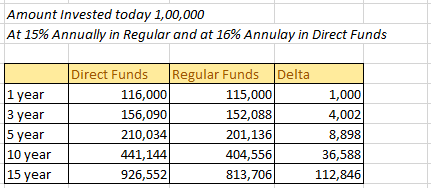
    Over the very long periods, the more realistic annualized returns for an equity funds would be in the range of 12-18%, expecting anything more than that is sheer luck. So, let's consider what would be the value of 1 lakh invested today at different periods for an annualized return in a regular and direct variant of a mutual fund giving 15% and 16% respective returns.

    Regular Vs Direct mutualfund plans
    Value of 1 lakhs over different periods in investments with 1% delta returns
    This may not look huge, but consider the fact that we used just one lakh as investment. Now, consider someone investing over a crore and building a retirement corpus and let's see how the numbers looks like now. The corpus at the end would differ by more than 1 crore. 

    Now, you may debate how much value a 1 crore would have after 15 years, that's totally up to you. But this is really called the power of compounding. What do you think?


    Thursday, May 4, 2017

    How to compare mutual funds?

    Mutual funds is one of the very important avenues of investments for any individual who wants to create wealth over time. I say this as this is the one route that provides you lot of flexibility in terms of your goal horizons, your risk taking capacity, potential returns and ease of purchase and redemptions.

    How most people compare mutual funds?

    I have many a times seen that my friends and colleagues start picking up funds based on their star ratings (more on this in, are you buying top rated funds?)

    Or, they simply see the high historical returns of the mutual funds and pick them. This is possibly because they have been investing in FD's and have been comparing interest rates since long. Why this is wrong? And the answer is for following reasons
    • While, for FDs it's ok to compare the interest rates, the rate of returns for mutual funds are not interest rates - they are instead historical rate of returns. Note, interest rates are for future and rates of returns are for past. 
    • Another important aspect that we ignore here is the associated risk - while FDs are fairly riskless, each mutual fund is different from other in terms of the associated risk and this is true even when they belong to same category (say both midcap funds)


    How to actually compare mutual funds?

    Hence, what we need to understand is the five key parameters that help us measure the risk of a fund's portfolio and allows us to compare this with another.


    Higher the better 

    • Alpha - alpha measures the funds performance with the index on risk adjusted basis. A positive value simply means given the same risk the fund would perform better than the index fund. So higher the alpha the better 
    • Sharpe Ratio - this is calculated by subtracting the risk-free rate of return (for layman terms, understand as avg FD return) from the rate of return for a fund and dividing the result by the fund's standard deviation of its return. Hence, higher the value the better

    Lower the better

    • Beta - this is measure of volatility and indicates the tendency of the mutual funds return to respond to swings in the market. The lesser the value the more stable the fund's portfolio 
    • Standard Deviation - this is spread of the returns of the mutual fund from its mean return. Now this helps you in understanding how far away the mutual fund's return deviates from its mean value. Hence, Lower the standard deviation the better
    • R-Squared - this basically measures how closely the fund tracks the index. The closer it is, lesser the chances to perform better than index. The lower it is means better the fund managed, more the value added by fund manager. You can simply assume, the lower the better
    Just memorize this image and you are done, now it would be easy to compare two funds. 

    Tuesday, May 2, 2017

    Equity as your child

    I remember reading this perspective from someone recently, and I kind of liked the way the author put this forward. Let me re-iterate what I read.

    If you have two kids, as a parent you would try to make sure that you provide for the need of both your kids in most fair manner. Now consider equity as your third child, and make sure that all the expenses that you make for your kids are simply divided by 3 and the third poriton goes to equity. Note that you must treat this as expense and not investment.

    Now, when you are 60 and your children are busy with their families and may and may not have time and willingness to provide you support, your third child will always be by your side and if you have been fair to him, he would have more than enough to provide for later years.

    Isn't this an interesting analogy to bring home the necessity of retirement goal.

    An individual may have many goals in life, however the top priority and number one goal in everyone's list should be retirement goal. This is the only mandatory goal one should have, others are really optional. And the key idea behind it is that if you don't provide for yourself who else will.

    Ponder upon, if you havn't so far. 

    Invest or prepay when you have smart home loan?

    One of my friend and colleague asked me whether my post on Invest or prepay home loan makes sense for the smart home loans as well. While writing that earlier post, I had this in mind but decided to keep this topic for another blog post, however did not expect this question coming so soon.

    Let's first see what are smart home loans, not many would be aware of that. 
    • Smart home loans are nothing more than a home loan given to you as an overdraft account with a defined withdrawal power, which is same as the amount of home loan sanctioned based on your re-payment capability, CIBIL score and property evaluations. 
    • Max Gain from SBI is the most popular such product in the market. Citi bank has Home Credit, HSBC has Smart home and some other banks also have similar product with different interest rates. 
    What are the benefits of smart home loan products?
    It allows you to deposit any amount of money in your home loan account. This is different from pre-paying your home loan, it just sits in there and reduces the principal amount for your home loan by that amount and thereby reducing your overall interest liability. 

    More on the smart home loans and its features in some other post. Let's come back to our original topic Invest or prepay when you have smart home loan. Answer to this question is little tricky because 
    • The kind of liquidity provided to the sum deposited in smart home loan is completely unbeatable, as it's next to cash
    • From return perspective, you can consider this sum earning the same interest as your home loan interest, which is actually tax free for you. 
    Now, considering these facts, here is my recommendation 
    • There are not lot many products in the market that could beat this combination. As some would have interest rate issues and others would have liquidity problems. 
    • Hence, you should put your following funds into the smart home loan account: 
      • emergency fund and medical fund 
      • any money that you have allocated for short to medium term goals (0-5 years) 
    • Anything that is allocated for beyond this period should be moved to equity mutual funds as you still have better returns there for that horizon. 
    Feel free to post your thoughts and opinions on this topic. 

    Monday, May 1, 2017

    Should I invest in NPS?

    NPS or National Pension Scheme is a voluntary scheme, where one should be contributing to build the retirement corpus until the age of 60 and beyond that derives pension from the acculmulated corpus. Hence, it's fundamentally a retirement product.

    During the accumulation phase, an individual keeps investing till the age of 60. At the age of 60 when he/she retires, then he is elligible for withdraw upto 60% from the corpus as lumpsum. For the balance corpus which is at-least 40%, he must buy an annuity that comes to him as monthly pension.

    Now, the question comes whether I should start putting my money in NPS or not? Well, I will try to answer that question, but a little later in the post. Before that let's list down what are the pros and cons of investing in NPS.

    Pros

    • This is one product that has least cost of maintenance/management amongst all the equity products available (MFs, ULIPs etc.). Just 100 would be charged as management fees for managing a fund of 10 lakhs. 
    • If you want to save for retirement and do not want to bother with balancing of your asset allocation over the years, then this is the product for you. Life stage option in NPS automatically moves your assets from equity to debt as you start aging. 
    • Tax benefit 
      • While contributing, the contribution in excess of 1.5 lakhs can be claimed as deduction against section 80CCD(1B)
      • At retirement, the 40% of the accumulated retirement corpus will be completely exempted from Tax
    Cons

    • The funds get locked till the day you retire, which is the age of 60. You might be in your early twenties or thirties and all your money gets blocked till you are 60. 
    • The max investment in equity is only 50% of the total contribution. Considering retirement for many would be the long term goal well over 10 years for many. There need to be an option to invest almost 100% in equity. That's where the investing directly in equity funds for retirement would be better. 
    • At the age of retirement you must buy annuity for atleast 40% pf the corpus. That may not be the most efficient investment from return perspective at that point in time, but you have no choice. Also the pension from annuity is taxable in your hands for that year. A systematic withdrawal plan from an equity fund would be much better in that case, and note these withdrawals from equity funds are tax free as they are coming from equity funds after 1 year of investment. 
    Hence, my take here would be, you would be better off investing directly in equity funds via SIP approach. When you are nearing 60s, 
    • you should start systematic transfer plans from these equity funds into aggressive/conservative debt oriented funds. 
    • And start a systematic withdrawal plan from these debt funds
    What do you think? Do you see anymore advantages of NPS? Do you think you would still want to buy an NPS?

    PS: There are chances that govt may start taxing the returns from equity funds which today are completely tax free after 1 year. If that happens we may have to review the attractiveness of the NPS with new scheme of things. However, till then i would say avoid NPS. 

    Sunday, April 30, 2017

    Cost of acquisition of house

    Sale of house is one of the major tax events for any individual. I have covered the tax implications for the sale of house here

    Now, another important thing to consider is the cost of acquisition itself for the house. House is not a commodity for which you pay via your credit card, it's typically done over a period and involves huge sum of money which is mostly coming from home loans. 

    Cost of Acquisition (COA) is defined as any capital expense incurred at the time of acquiring the capital asset. Hence, it includes all the expenses incurred to complete the acquistion of the asset. 

    Apart from the money paid for the house as agreed with the seller, following can be added to this sum for calculating cost of acquisition of the house while computing capital gains
    • Expenses done towards registration and stamp duty can be added to the cost of acquisition of the house
    • 1% TDS paid to the government on behalf of seller is definitely part of the cost of acquisition and must not be overlooked 
    • Expenses incurred on repairs and renovation can be added to the cost of acquisition of the house 
    • The interest paid on the home loan taken for the purchase of this house can also be added to the cost of the house. Refer this link for more info
    • Brokerage paid to broker is also one of the expense for the purchase of house and can be added to the cost of acquisition
    There could be more expenses associated with the purchase and hence you need to make sure you record and add all of them correctly while arriving at the cost of acquisition of the property. 

    Tax on sale of house

    Selling a house is one of the important tax events that you should consider before committing to the sale. All the profits that you make from the sale are taxable.

    Following scenarios will help you understand the quantum of the tax implications you have based on when you sell.

    Case
    Scenario 1: Sales within less than 3 years of purchase
    Scenario 2: Sales after more than 3 years but less than 5 years of purchase
    Scenario 3: Sale after more than 5 years of purchase
    Example
    You bought a house for 50 lakhs and sold the house by 2nd year for around 60 lakhs. You made the profit of 10 lakhs
    You bought a house for 50 lakhs and sold the house by 4th year for around 70 lakhs. You made the profit of 20 lakhs
    You bought a house for 50 lakhs and sold the house by 6th year for around 80 lakhs. You made the profit of 30 lakhs
    Tax Treatment
    This whole sum of 10 is treated as a short-term capital gain in your hands and gets added to your income for the year of sale (for joint owners it's added to their respective incomes in the ratio of their ownerships). And hence, its taxed as per your tax slabs
    This whole sum of 20 lakhs is treated as long term capital gain and taxed at the rate of 20% after indexation. However, note that there is a catch if you are selling in this window of 3-5 years from purchase, the tax benefits which were claimed earlier will have to be reversed.

    The tax deduction claimed for the principal repayment, stamp duty and registration under Sec 80C are reversed and the amount becomes taxable in the year of sale. Only the deduction of the interest payment under Section 24B is left untouched
    This whole sum of 30 lakhs is treated as long term capital gain and taxed at the rate of 20% after indexation. In this case you have no reversal of the tax benefits that you have claimed till date
    Ways to avoid Tax
    There is no way you can avoid paying tax on that. You can only set-off the gains against the short-term losses from the same year on the sale of other assets.
    If you use the entire gain from the transaction to buy another house within two years or construct another house within three years. In case the entire capital gains are not invested, the balance is charged to long-term capital gains tax. Note that the entire tax exemption will still be reversed in this scenario. 
    It's all same as scenario two except that there is no reversal of tax exemptions claimed by you. 

    In each case, you can also minimize the profits that is liable for tax by making sure you have calculated your cost of acquisition of the house correctly.

    In case you don't want to invest the capital gain proceeds in another house, but still want to save tax then you have the following options
    • Claim exemption under Section 54 (EC), and in this case you should be investing for 3 years in bonds of NHAI and RECL within 6 months of sale of house. The max limit to save via this way is 50 lakhs. 
    • You may also set-off capital gains against any long term capital losses from the sale of other assets. And these could be from the same financial year, or the ones you have been accumulating from last 8 years.
    So, you would have realized now, you should be keeping your house for at-least 5 years before deciding to sell it, if you are looking at it from tax efficiency perspective. 


    Are you investing without having goals?

    I developed a habbit of saving since the year I start my Job. However, i used to simply created fixed deposits or recurring deposits with whatever I felt like I won't need during that month.

    That approach worked well for me to some extent as I was at-least saving, however today when I look back I would not advice that approach to any young earner. I call it dangling investments.

    I say this as now I beleive in the following principal 
    "If you don't know where you want to go then any road can take you there"
    This simply means if you are putting money into some investment avenues and you don't know what are you gonna use it for the following is going wrong 
    • You don't know when you will need that money - short term, medium term or long term. And hence you might have made a choice of investment that is possibly not giving you right returns for the time it would have been invested. Putting money in FDs for say over 5 years is a financial sin you must not commit unless you have really strong reasons to do so.
    • You don't know whether you are over investing or under investing - you may be saving some 25k everymonth. Now, how would you know if that would be enough to meet your future needs in case of emergencies or your live events. Unless you know what you are investing for and the time horizon, your quantum could be completely wrong. 
    • You don't know how much you can pull out from investments - Suppose you have been saving and have 50 lakhs in your investments. Now, you feel need of buying that awesome car, and you pull out 20 lakhs from your investments. Is it what you should be doing? No, right this one unknown bucket investments has money for your retirement, your kids education, buying a house and buying the car should be least of your priority against most these goals
    Hence, its always prudent to decide your goals (the detination) and the time horizon when you want to reach there. This clarity will even help in your day to day decisions that you take, you will always we clear whether you have enough to splurge on your daily whims and desires. 

    And once you have your goals figured out, you need to definitely put down a plan that you should be reviewing every few months to have a pulse check. A plan is very important as a goal without a real plan is just another dream. I hope i made my point. 

    Saturday, April 29, 2017

    Are you buying top rated mutual funds?

    Most of us investing in mutual funds will go to the likes of moneycontrol and economictimes and start looking for top rated funds to invest. Is this the right strategy, to some extent I would say it's not.

    I say this for following reasons
    • Rank always reflects how the fund has been performing in past and does not guarantee that the same fund would be performing well in future. 
    • If you are investing in top rated funds, everyone else is also doing the same. Hence, the fund manager starts getting lot of inflows to the funds which are difficult to depoly in good quality assests. Over the period this would end up avergaging out the quality of the assets and hence dipping the performance of the fund. 
    Hence, don't choose rating as the only parameter for choosing fund. You should as well see the other factors 
    • Funds rank in the category for 1 year, 3 year, 5 year, 10 years and since launch
    • Funds that have performed well during the market crashes
    • Fund managers track record 
    • Funds investment style
    To keep it simple, choose really few funds one to two equity funds, one-two hybrid funds and one-two debt funds. Don't go for more than a fund or two in any category. And review your portfolio every 6 months at-least. 

    Diversification of portfolio

    Anyone who has been investing would know what a portfolio means and what are the typical assets an individual would have. He would also know that diversification of the portfolio is important, however I am writing this one to re-iterate the fact that diversification is important, but over diversification is not.

    Let's first understand the aspects of assests that need to be understood well, which are liquidity, return and risk. 

    Liquidity: Normally there are following types of assests: fixed assets like property or land and liquid assets like cash or savings account and finally equities/funds etc. which fall in between the spectrum of these two extreems. 

    Return: Return is typically measured as the Annual rate of return for the given asset. For instance cash has 4% return, FDs have 7% returns, Debt funds offer mostly a little better and equities even better for longer horizon and then properties some time provide staggering returns for investors. However, no one should ever consider only return for an asset alone. I say this because typically the moment the potential for the return increases it does come along with increased risk and volatility. 

    Risk: Definition of risk is basically the volatility of returns for an asset, and this volatility sometime ends up eating from your principal as well. Its not always feasible to measure the risk for the investment. You should have a mitigation plan for this aspect, and one of the mitigation approach is Diversification. 

    Note that some structured investments like mutual funds and equities do have alpha values, that help you determine the risk adjusted returns from these investments. But then there are property investments which are very local to the nature, location and type of property and cannot be so generalised.

    So, in summary diversification of portfolio helps us average out excessive volatility in any given asset and help provide stability to the whole portfolio. 

    However, over diversification simply adds up to the hassles of maintenance of the assets rather than helping a lot.

     A typical example would be of an individual investing in top 5 mutual funds of say mid-cap category. Now, each of those funds are by nature diversified and they all end-up investing in same universe of equities and hence there is no much sense behind holding more than 1-2 funds of a specific category. 

    Another would be holding too many properties, property consumes a huge quantum of your money and hence more than one would really skew your portfolio towards a particular type of asset. And then you would take years to balance, or you may never be able to balance the risk and volatility that might come from this kind of asset. 

    I think with all this I have made my point on Diversification
    • The need of diversification
    • And how not to overdo it 
    So, the golden rule is "too much of anything is bad", you have not heard it first time :)

    Invest or prepay home loan?

    I took my first home loan around 2011 to buy a flat in Bangalore, I kept the loan amount to around 30 lakhs and rest of the money i pulled up from my PPF accounts, liquidated our FDs and borrowed from my dad and dad-in-law. 

    The strategy that I followed during that time, was to immediately start pre-paying the money that I borrowed from Dad and Dad-in-law and once that was over I continued paying my home loan. Now, it was the time when I dad was retiring from his Bank job and we felt need to 3BHK as i wanted my parents to stay with me. 

    It was a easy choice, we just wanted to move in a 3BHK, however the question was to rent or to buy? Well, this lot of people have this on top of their minds, however i will keep this topic for another blog post. But for now, would say we decided to buy a house. 

    And, that's when I realized I wasn't doing right paying off my home loan which was at rate of 9%. Why? The reason is simple, I wanted to buy a property again and I had no money to give my contribution as only 80% could be funded by banks or financial institutions. 

    This is when I made decision not to pre-pay loans, for 
    • This is the cheapest form of money that you can borrow in India today. All personal loans, credit cards, car loans etc. are much more than what home loan provides. 
    • You have the benefits on interest payments and principal can be shown in 80C, which no other type of loan has
    • You should build your own corpus that you can use to pre-pay anyday you want. But you can use it for any emergencies you may need. I am talking about emergency funds and the equity fund investments here (refer buckets of money), which can give you over 12% tax free return over years and far better than paying off your 9% home loan. 
    Well, luckily I bought that 3BHK and could arranged the funds, thanks to my dad as I could again borrow from him having paid back my earlier borrowings. And as well timely sale of my 2BHK which gave me comfortable position to move into a flat that is my present Home now.

    So, I would anyday suggest to start investing the money than pre-pay loan. However, if you are not really comfortable with the qunatum of loan that you had to take, would suggest to clear off part of it but don't put all your money to pre-pay it.

    Hope, that makes sense to you as well.

    PS: In case you have picked up a smart home loan product, then the dynamics of that is a bit different there and hence I have covered this separately in Invest or prepay when you have smart home loan.

    Friday, April 28, 2017

    Investing in MFs, the right way

    Say you have been an investor in mutual funds since over 10 years now and like how I started, you also started with ICICIDirect, Indiabulls etc - your one stop shop for all investments including mutual funds.

    Beleive me, if I tell you that you should not be continuing that approach anymore. This is because around 2013 SEBI has mandated all fund houses to have a "Direct" variation of each "Regular" fund they had.

    So, what are "Regular Funds"?
    Traditionally, all fund houses would give commissions to brokers that have been helping them to sell the funds to the individual investors. And these commissions would come from the mutual fund corpus and hence contributes to the expense ratio of the fund. This was all done irrespective of whether you bought your fund from a nearby broker, online broker like ICICIDirect, IndiaBulls etc. or you went to CAMS/Karvy offices to make the transaction in the Mutual Fund. These are Regular funds - means broker commision is charged to expense ratio.

    Then what are "Direct Funds"?
    Direct funds are nothing but, the no-broker variation of the regular mutual funds. All the things remains exactly same from investment perspective - fund manager, holdings etc. However, for these funds the fund houses do not charge the commision to the Direct funds corpus, hence they typically have lower expense ratio i.e. lower cost of maintenance for the fund.

    Few key facts to note
    • Each fund that exists has both Direct and Regular funds
    • No online Broker will sell Direct fund, it's obvious isn't it?
    • Expense ratio for Direct funds is typically 50% of that of Regular funds
    • %Age annual return for Direct funds is typically 1% higher that regular funds

    Now, with all this, you know which type of funds to buy. Beleive me, the cumulating effects of this 1% increase over a longer horizon will definitely make the difference to the corpus.

    If you are not convinced on the facts and really want to see how much it would matter, check out the regular vs direct mutual funds post to see the actual power of compounding.