Showing posts with label Mutual Funds. Show all posts

Tuesday, June 6, 2017

fixed deposits or debt funds?

Fixed deposits or debt funds? Well, that's a question that I have heard quite a few times in recent days. They are different instruments and neither fixed deposits or debt funds can be completely ignored. Hence, you need to understand when to use what and the risk associated with them. 

Fixed deposits are the deposits done with financial institutions like banks against a fixed rate of return for a fixed period of time. And this is mostly considered risk free, although it's not, and can be broken easily these days via net banking and hence quite liquid as well. Why I say fixed deposits are not risk free - if your bank goes bankrupt, then irrespective of how many crores bank owes to you, you would only be entitled for a lakh or two. 

Debt funds are the mutual funds that invest debt instruments like bonds, debentures, government loans, structured loans etc. Read more on the details of types of debt funds.  

Below is a quick comparison of both the products 


Fixed Deposits
Debt Funds
Rate of return
Gives you a fixed rate of return irrespective of market conditions
Gives you a rate of return which is typically higher than that of corresponding fixed deposit for similar tenure as the redemption period.
Associated Risk
Fixed deposits are considered risk free.
Since these invest in market debt instruments, they are considered riskier than the fixed deposits. The longer the tenure of the bonds the fund is investing in the higher the associated risk and higher the potential return
Liquidity
Fixed deposits now a days can be closed online. And many banks provide you instant credit of the proceeds - however the rate of interest applied would be for the period FD is held and some amount deducted as penalty for pre-mature closure
Liquid funds now a days provide you an instant credit option.
All other funds would credit you the proceeds within a matter of 2-3 working days. Also, note that some debt funds have exit load as well if held below a given period.
The units are redeemed at market NAV
Part Redemption
Some banks do offer fixed deposits with swipe out facility. Which means while withdrawal, only the amount short in your savings account would be pulled out from your fixed deposit. However, not all FDs are of this nature and can only be redeemed in full.
Debt funds allow you to put in and pull out as much money as you want and whenever you want.
TDS
Banks deduct 10% TDS from the fixed deposits every year and that is submitted to government.
Hence, if you keep the money in FD for three years, every year you have TDS deducted from the interest accrued
There is no TDS deducted from mutual funds, the whole interest earned stays with you till the time you really go for redemption of the units.
Hence, tax is deferred till redemption
Tax Treatment
Interest earned on Fixed deposits is simply added to your income and taxed based on your tax slabs. This is irrespective of the number of years you hold the fixed deposits.
Income from debt funds i.e. redemption value - invested value for the given units is short term gain if redeemed before 3 years else it is capital gain.
Short term gains are added to your income and taxed based on your tax slabs.
Capital gains are calculated with indexation benefit, and taxed at 20% irrespective of your tax slabs.

I beleive above comparison is good enough to help you make right decision to choose your vehicle of investments. 

Monday, May 29, 2017

Debt and hybrid funds

Debt and hybrid funds
I have met few people recently who are aware of mutual funds and have been investing in them for quite some time, however it was surprising for me that they equate mutual funds to directly equity funds. They were not aware of the debt funds at all, leave apart the different categories of these funds and how they can leverage them.

Well this prompted me to pen down some basics on the debt and hybrid funds

What are debt funds?

Debt funds are basically mutual funds which invests full or part of their corpus in debt instruments like company bonds, govt bonds, loans to state governments, structured debts, debenture said etc. These instruments are rated by credit agencies (AAA and A1 ratings considered safer).

These instruments are slightly riskier than your fixed deposits and hence the institutions offering them compensate this risk by offering higher return. These instruments vary on maturity, the nearer the bond to its maturity the lower the risk and lower the premium. And hence, funds investing in bonds of longer maturity typically generate more returns than the ones investing in shorter maturity bonds.

Debt funds provide you an opportunity to earn more than your bank fixed deposits with tax benefits. From the tax benefit perspective just remember - for investment in debt funds for over 3 years your income is taxed @20% with indexation benefits.

Like equity funds there are both open ended and close ended funds. Most of the debt funds are open ended, however there are close ended funds typically called Fixed Maturity plans. They can only be subscribed during NFO's and can only be redeemed on maturity. FMPs are a very good alternative to fixed deposits in banks.

Debt funds on basis of debt maturity period

This classification is based on the maturity period of the debt instruments. It has nothing to do with how long you are holding the fund. 

Liquid Funds
Upto 91 days
Ultrashort term funds
Typically 91 days to 18 months
Short term funds
Typically 12 months to 36 months, sometimes even more
Income Funds
Really Flexible, 1 year to even 15-20 years

 Apart from this there are special funds that only invest in securities issued by central or state governments or provide loans to govt. These are called Gilt funds, Unlike bonds issued by companies, the chance of the Government defaulting on its loan obligation is significantly lower. 

Now, a combination of maturity and gilt nature provide the following options 
  • Short term gilt funds 
  • Medium-long term gilt funds 
All, the fund types mentioned above are the ones that only invest in debt instruments with no component of equities at all. 

Debt funds with mix of equity (Hybrid Funds)

These are basically funds that are classified as debt funds as they have major portion of their corpus invested in debt instruments and less in equity. Their tax treatment is same as that of any other debt fund. 

The classification here is based on the amount of corpus investible in debt and equities. 
  
Conservative Debt Funds
Upto 10% equity and rest in debt
Moderate Debt Funds
Upto 20% equity and rest in debt
Aggressive Debt Funds
Upto 30% equity and rest in debt
Equity oriented Debt funds
More than 65% in equity rest in debt

Now, since equity oriented debt funds have more than 65% in equity the tax treatment of them is same as that of equity funds. This is a very important factor to keep in mind while working with these funds. 

Asset allocation funds

These are special funds, where an investor does not need to bother about how much to put in equity and how much in debt. These funds makes the asset allocation decision between equity and debt based on the fund manager's view of the market direction and try to optimize the returns for the end investor. 

They are also called fund of funds and invest in other debt or equity funds. Note that due to this nature of these funds, they have a double incidence of expense ratio on your investments - one at the actual fund level and another at the asset allocation fund level. 

Arbitrage funds 

These funds aim to capture arbitrage opportunities in the cash and derivative market and invest some portion in the debt segment. In layman terms, since the market can never be in synch on the prices of the same stock at two different places - they take advantage of this difference. For instance, it's like you buy an item at flipkart on discount and sell the same on amazon at MRP, the delta/arbitrage is yours. 

I believe this gives you a holistic view of the debt and hybrid funds and would help in taking more informed decisions for your investments. 

Friday, May 12, 2017

how to invest in direct funds?

This post is relevant for you only if you have understood that you should be investing in mutual funds.

And if you are still here, let me ask you - do you know the difference between direct and regular mutual funds? If yes, and you are still continuing with your existing online portal to invest in regular funds for the sake of convinience, then you should read here to know how much more you will make if you go the direct way.

Once you have reached here, I am assuming you are convinced that you should be investing in mutual funds and you should be investing in their direct variants only. However, you would want to know where to start. 


CAMS
You can invest directly through KRAs like CAMS
You can also do your Aadhar based eKYC at CAMS
Investor Services provided by CAMSList of Mutual Funds serviced by CAMS
Use their mail back services to get consolidated statement
Karvy
You can invest directly through KRAs like Karvy
You can also do your Aadhar based eKYC at Karvy
Investor Services provided by Karvy
List of Mutual Funds serviced by Karvy
Use their mail back services to get consolidated statement
    MFutilties
    Another central Agency that allows you to invest directly in mutual funds. https://www.mfuindia.com/ 

    This also allows you to have one CAN number (Common Account Number), through which you can consolidate all your folios across KRAs. 
    Mutual fund Websites
    If you have your KYC done and your correct email address and mobile number stored in the KYC, then you can directly register on mutual funds websites to start investing. some of the sites are like given below 

    Note that all of these have online websites to do your transactions from and as well a mobile apps for both IOS and Android devices.

    Personally, I have used the CAMS, mfutilities and mutual fund websites and they are all good. The one that i use most often is the CAMS website and their IOS app, which is really secure and good.

    There are websites like coin from zerodha and moneyfront.in that allows investing in direct funds by charging a flat minimal fee monthly of Rs. 50 to 100, irrespective of the amount of transaction done. Hence, there is little cost to this convenience. 

    Friday, May 5, 2017

    Regular vs direct mutual fund plans

    I posted on this topic few days back in Investing the MF's, the right way. I thought just the fact that direct funds have lower expense ratio and better annualized returns it would be more than enough to make the decision to go the direct way.

    However, today while in a discussion with someone on the topic, I got an argument stating how much would that 1% difference in expense ratio make against the convenience of investing in Mutual Funds through one portal and viewing your consolidated portfolio at one place. A valid argument, hence i thought let's do some number crunching to see what is the quantum of benefit one is trading for the convenience.

    I picked up three toprated funds from valueresearchonline.com, and simply checked the delta between their corresponding direct and regular plans. I picked  only till 3 years as Direct funds came in to existence around 2013.

    Note, that direct plans always always always have more returns than corresponding regular plans.

    Regular Vs Direct mutualfund plans
    Annualized returns for three large cap funds for 1 and 3 years period
    Observe that typically there is a delta of more than 1% in annual returns of these funds, and this is coming from the expense savings done on commissions to brokers.

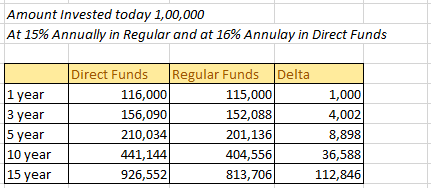
    Over the very long periods, the more realistic annualized returns for an equity funds would be in the range of 12-18%, expecting anything more than that is sheer luck. So, let's consider what would be the value of 1 lakh invested today at different periods for an annualized return in a regular and direct variant of a mutual fund giving 15% and 16% respective returns.

    Regular Vs Direct mutualfund plans
    Value of 1 lakhs over different periods in investments with 1% delta returns
    This may not look huge, but consider the fact that we used just one lakh as investment. Now, consider someone investing over a crore and building a retirement corpus and let's see how the numbers looks like now. The corpus at the end would differ by more than 1 crore. 

    Now, you may debate how much value a 1 crore would have after 15 years, that's totally up to you. But this is really called the power of compounding. What do you think?


    Thursday, May 4, 2017

    How to compare mutual funds?

    Mutual funds is one of the very important avenues of investments for any individual who wants to create wealth over time. I say this as this is the one route that provides you lot of flexibility in terms of your goal horizons, your risk taking capacity, potential returns and ease of purchase and redemptions.

    How most people compare mutual funds?

    I have many a times seen that my friends and colleagues start picking up funds based on their star ratings (more on this in, are you buying top rated funds?)

    Or, they simply see the high historical returns of the mutual funds and pick them. This is possibly because they have been investing in FD's and have been comparing interest rates since long. Why this is wrong? And the answer is for following reasons
    • While, for FDs it's ok to compare the interest rates, the rate of returns for mutual funds are not interest rates - they are instead historical rate of returns. Note, interest rates are for future and rates of returns are for past. 
    • Another important aspect that we ignore here is the associated risk - while FDs are fairly riskless, each mutual fund is different from other in terms of the associated risk and this is true even when they belong to same category (say both midcap funds)


    How to actually compare mutual funds?

    Hence, what we need to understand is the five key parameters that help us measure the risk of a fund's portfolio and allows us to compare this with another.


    Higher the better 

    • Alpha - alpha measures the funds performance with the index on risk adjusted basis. A positive value simply means given the same risk the fund would perform better than the index fund. So higher the alpha the better 
    • Sharpe Ratio - this is calculated by subtracting the risk-free rate of return (for layman terms, understand as avg FD return) from the rate of return for a fund and dividing the result by the fund's standard deviation of its return. Hence, higher the value the better

    Lower the better

    • Beta - this is measure of volatility and indicates the tendency of the mutual funds return to respond to swings in the market. The lesser the value the more stable the fund's portfolio 
    • Standard Deviation - this is spread of the returns of the mutual fund from its mean return. Now this helps you in understanding how far away the mutual fund's return deviates from its mean value. Hence, Lower the standard deviation the better
    • R-Squared - this basically measures how closely the fund tracks the index. The closer it is, lesser the chances to perform better than index. The lower it is means better the fund managed, more the value added by fund manager. You can simply assume, the lower the better
    Just memorize this image and you are done, now it would be easy to compare two funds. 

    Monday, May 1, 2017

    Should I invest in NPS?

    NPS or National Pension Scheme is a voluntary scheme, where one should be contributing to build the retirement corpus until the age of 60 and beyond that derives pension from the acculmulated corpus. Hence, it's fundamentally a retirement product.

    During the accumulation phase, an individual keeps investing till the age of 60. At the age of 60 when he/she retires, then he is elligible for withdraw upto 60% from the corpus as lumpsum. For the balance corpus which is at-least 40%, he must buy an annuity that comes to him as monthly pension.

    Now, the question comes whether I should start putting my money in NPS or not? Well, I will try to answer that question, but a little later in the post. Before that let's list down what are the pros and cons of investing in NPS.

    Pros

    • This is one product that has least cost of maintenance/management amongst all the equity products available (MFs, ULIPs etc.). Just 100 would be charged as management fees for managing a fund of 10 lakhs. 
    • If you want to save for retirement and do not want to bother with balancing of your asset allocation over the years, then this is the product for you. Life stage option in NPS automatically moves your assets from equity to debt as you start aging. 
    • Tax benefit 
      • While contributing, the contribution in excess of 1.5 lakhs can be claimed as deduction against section 80CCD(1B)
      • At retirement, the 40% of the accumulated retirement corpus will be completely exempted from Tax
    Cons

    • The funds get locked till the day you retire, which is the age of 60. You might be in your early twenties or thirties and all your money gets blocked till you are 60. 
    • The max investment in equity is only 50% of the total contribution. Considering retirement for many would be the long term goal well over 10 years for many. There need to be an option to invest almost 100% in equity. That's where the investing directly in equity funds for retirement would be better. 
    • At the age of retirement you must buy annuity for atleast 40% pf the corpus. That may not be the most efficient investment from return perspective at that point in time, but you have no choice. Also the pension from annuity is taxable in your hands for that year. A systematic withdrawal plan from an equity fund would be much better in that case, and note these withdrawals from equity funds are tax free as they are coming from equity funds after 1 year of investment. 
    Hence, my take here would be, you would be better off investing directly in equity funds via SIP approach. When you are nearing 60s, 
    • you should start systematic transfer plans from these equity funds into aggressive/conservative debt oriented funds. 
    • And start a systematic withdrawal plan from these debt funds
    What do you think? Do you see anymore advantages of NPS? Do you think you would still want to buy an NPS?

    PS: There are chances that govt may start taxing the returns from equity funds which today are completely tax free after 1 year. If that happens we may have to review the attractiveness of the NPS with new scheme of things. However, till then i would say avoid NPS. 

    Saturday, April 29, 2017

    Are you buying top rated mutual funds?

    Most of us investing in mutual funds will go to the likes of moneycontrol and economictimes and start looking for top rated funds to invest. Is this the right strategy, to some extent I would say it's not.

    I say this for following reasons
    • Rank always reflects how the fund has been performing in past and does not guarantee that the same fund would be performing well in future. 
    • If you are investing in top rated funds, everyone else is also doing the same. Hence, the fund manager starts getting lot of inflows to the funds which are difficult to depoly in good quality assests. Over the period this would end up avergaging out the quality of the assets and hence dipping the performance of the fund. 
    Hence, don't choose rating as the only parameter for choosing fund. You should as well see the other factors 
    • Funds rank in the category for 1 year, 3 year, 5 year, 10 years and since launch
    • Funds that have performed well during the market crashes
    • Fund managers track record 
    • Funds investment style
    To keep it simple, choose really few funds one to two equity funds, one-two hybrid funds and one-two debt funds. Don't go for more than a fund or two in any category. And review your portfolio every 6 months at-least. 

    Friday, April 28, 2017

    Investing in MFs, the right way

    Say you have been an investor in mutual funds since over 10 years now and like how I started, you also started with ICICIDirect, Indiabulls etc - your one stop shop for all investments including mutual funds.

    Beleive me, if I tell you that you should not be continuing that approach anymore. This is because around 2013 SEBI has mandated all fund houses to have a "Direct" variation of each "Regular" fund they had.

    So, what are "Regular Funds"?
    Traditionally, all fund houses would give commissions to brokers that have been helping them to sell the funds to the individual investors. And these commissions would come from the mutual fund corpus and hence contributes to the expense ratio of the fund. This was all done irrespective of whether you bought your fund from a nearby broker, online broker like ICICIDirect, IndiaBulls etc. or you went to CAMS/Karvy offices to make the transaction in the Mutual Fund. These are Regular funds - means broker commision is charged to expense ratio.

    Then what are "Direct Funds"?
    Direct funds are nothing but, the no-broker variation of the regular mutual funds. All the things remains exactly same from investment perspective - fund manager, holdings etc. However, for these funds the fund houses do not charge the commision to the Direct funds corpus, hence they typically have lower expense ratio i.e. lower cost of maintenance for the fund.

    Few key facts to note
    • Each fund that exists has both Direct and Regular funds
    • No online Broker will sell Direct fund, it's obvious isn't it?
    • Expense ratio for Direct funds is typically 50% of that of Regular funds
    • %Age annual return for Direct funds is typically 1% higher that regular funds

    Now, with all this, you know which type of funds to buy. Beleive me, the cumulating effects of this 1% increase over a longer horizon will definitely make the difference to the corpus.

    If you are not convinced on the facts and really want to see how much it would matter, check out the regular vs direct mutual funds post to see the actual power of compounding. 

    Should I buy low NAV funds?

    Its a common wisdom that it's good to buy anything cheap. And that's exactly what works fine for equities. You buy them cheap and sell them at higher price. All good.

    Now, coming to mutual funds, should you similarly buy funds with low NAV? The answer to that is "it does not really matter". If you know this, you can ignore this post. 

    However, if you are wondering that why it does not matter, then here is the answer. NAV is not the price of the mutual fund that you buy, and hence the same logic does not apply. 

    During an NFO (New Fund Offer), a fund house (AMC) makes an offer. Now, say 10 people invested in that fund say Rs. 100 each. 
    • Now the fund corpus stands at Rs. 1000
    • Each of the 10 individuals have for 10 units each of Rs. 10 
    Now, the fund when listed has invested this Rs. 1000 in equities and debt instruments, and over the period has made some profits and the money has finally grown to be 1600. 
    • Now the fund corpus stands at Rs. 1600
    • Each of the 10 individuals have 10 units each
    • In order to reflect the profit of each individual, NAV of the fund has grown to 16
    Now, when as an eleventh investor I want to buy fresh units in the fund. I need to buy it at 16, so that the profit made by those intial 10 investors does not really get disctributed. Makes sense right?

    Hence, any day it does not matter whether NAV is low or High, what matters is 
    • What's the performance of a fund?
    • Where does it typically invest?
    • How well it has performed during market crashes?
    • And so on ... 
    So, let's now put Low/High NAV question to rest forever.