Saturday, May 6, 2017

Are you holding endowment policies or ULIPs?

Are you holding any of the endowment policies or ULIPS? If yes, then you should be definitely reading this one.

I have never help ULIPS and had an endowment policy once. I did not buy it for myself, however when i started earning, my dad gifted this to me. This was based on the traditional wisom, most of the people from his generation would know this. Anyways, I was very happy then that I was saving tax, completely ignorant on the personal finance topic.

This endowment policy from LIC was bought in July 2006, was of 25 years term and insured me for 10 lakhs and was costing me around 37,600 per year. Historically, when such a policy is redeemed it would have given me around 20 lakhs plus.

In the year 2012, when I was also learning the concepts of future value and how to compare value of annuities etc.during my MBA, I decided to analyze this one as I always had a feeling that this is not something that is right for me.

What I observed:

  • If I receive 20 lakhs at the end of 25 years, for an annual investment of 37,600 for 25 years, the pre-tax rate of return comes out to meagre 6%, even a PPF has much higher, at-least then. 
  • The insurance of 10 lakhs is nothing for the kind of cover I needed. I was looking at a cover of at-least 1 crore to cover the liabilities I had then. 
  • Disclaimer: I did not consider the 80C benefits from the policy, as I was paying a home loan and principal payment and PPF easily covered much more than allower limit. 
What I realized

  • To get a tax free return after 25 years, I could have simply put that money in PPF or even in equity funds 
    • In PPF at the rate of 8% I would have needed 28,000 annually to generate similar returns. 
    • In equities at the rate of 14% I would have needed just 11,500 annualy. 
  • I could easily buy a term insurance of 1 Crore for life (endowment insured for 25 years only for one-tenth amount) at cost of 12,500 annually
  • Now, considering the term was 25 years, I would have gone for equities mostly, and would have had a much better deal in 34,000 (11,500 + 12,500) annually, with a flexibility to tweak my equity invesments whenever I like. 

I had to convince my dad that it makes sense to surrender the policy, the concept of sunk cost is very useful while making such decisions. And i did surrender the policy, even after I had paid the installements for 8 years.

Similarly, ULIPS also are mixed products - providing equity investments and insurance together. And if you analyze them then you are easily better off by having more insurance and better returns when you buy these separately.

Hence, I would recommend to anyone

  • If you don't have it, don't bother you don't need them anyways 
  • if you have it, then get out of them as soon as possible (in most cases, except the ones when you are very near to endowment policy maturity)
Feel free to reach out, if you want more details on the subject.
Happy to help.

Friday, May 5, 2017

Regular vs direct mutual fund plans

I posted on this topic few days back in Investing the MF's, the right way. I thought just the fact that direct funds have lower expense ratio and better annualized returns it would be more than enough to make the decision to go the direct way.

However, today while in a discussion with someone on the topic, I got an argument stating how much would that 1% difference in expense ratio make against the convenience of investing in Mutual Funds through one portal and viewing your consolidated portfolio at one place. A valid argument, hence i thought let's do some number crunching to see what is the quantum of benefit one is trading for the convenience.

I picked up three toprated funds from valueresearchonline.com, and simply checked the delta between their corresponding direct and regular plans. I picked  only till 3 years as Direct funds came in to existence around 2013.

Note, that direct plans always always always have more returns than corresponding regular plans.

Regular Vs Direct mutualfund plans
Annualized returns for three large cap funds for 1 and 3 years period
Observe that typically there is a delta of more than 1% in annual returns of these funds, and this is coming from the expense savings done on commissions to brokers.

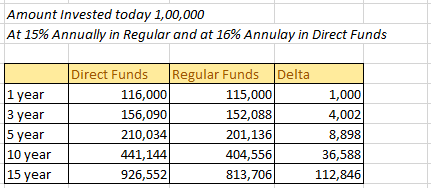
Over the very long periods, the more realistic annualized returns for an equity funds would be in the range of 12-18%, expecting anything more than that is sheer luck. So, let's consider what would be the value of 1 lakh invested today at different periods for an annualized return in a regular and direct variant of a mutual fund giving 15% and 16% respective returns.

Regular Vs Direct mutualfund plans
Value of 1 lakhs over different periods in investments with 1% delta returns
This may not look huge, but consider the fact that we used just one lakh as investment. Now, consider someone investing over a crore and building a retirement corpus and let's see how the numbers looks like now. The corpus at the end would differ by more than 1 crore. 

Now, you may debate how much value a 1 crore would have after 15 years, that's totally up to you. But this is really called the power of compounding. What do you think?


Thursday, May 4, 2017

How to compare mutual funds?

Mutual funds is one of the very important avenues of investments for any individual who wants to create wealth over time. I say this as this is the one route that provides you lot of flexibility in terms of your goal horizons, your risk taking capacity, potential returns and ease of purchase and redemptions.

How most people compare mutual funds?

I have many a times seen that my friends and colleagues start picking up funds based on their star ratings (more on this in, are you buying top rated funds?)

Or, they simply see the high historical returns of the mutual funds and pick them. This is possibly because they have been investing in FD's and have been comparing interest rates since long. Why this is wrong? And the answer is for following reasons
  • While, for FDs it's ok to compare the interest rates, the rate of returns for mutual funds are not interest rates - they are instead historical rate of returns. Note, interest rates are for future and rates of returns are for past. 
  • Another important aspect that we ignore here is the associated risk - while FDs are fairly riskless, each mutual fund is different from other in terms of the associated risk and this is true even when they belong to same category (say both midcap funds)


How to actually compare mutual funds?

Hence, what we need to understand is the five key parameters that help us measure the risk of a fund's portfolio and allows us to compare this with another.


Higher the better 

  • Alpha - alpha measures the funds performance with the index on risk adjusted basis. A positive value simply means given the same risk the fund would perform better than the index fund. So higher the alpha the better 
  • Sharpe Ratio - this is calculated by subtracting the risk-free rate of return (for layman terms, understand as avg FD return) from the rate of return for a fund and dividing the result by the fund's standard deviation of its return. Hence, higher the value the better

Lower the better

  • Beta - this is measure of volatility and indicates the tendency of the mutual funds return to respond to swings in the market. The lesser the value the more stable the fund's portfolio 
  • Standard Deviation - this is spread of the returns of the mutual fund from its mean return. Now this helps you in understanding how far away the mutual fund's return deviates from its mean value. Hence, Lower the standard deviation the better
  • R-Squared - this basically measures how closely the fund tracks the index. The closer it is, lesser the chances to perform better than index. The lower it is means better the fund managed, more the value added by fund manager. You can simply assume, the lower the better
Just memorize this image and you are done, now it would be easy to compare two funds. 

Tuesday, May 2, 2017

Equity as your child

I remember reading this perspective from someone recently, and I kind of liked the way the author put this forward. Let me re-iterate what I read.

If you have two kids, as a parent you would try to make sure that you provide for the need of both your kids in most fair manner. Now consider equity as your third child, and make sure that all the expenses that you make for your kids are simply divided by 3 and the third poriton goes to equity. Note that you must treat this as expense and not investment.

Now, when you are 60 and your children are busy with their families and may and may not have time and willingness to provide you support, your third child will always be by your side and if you have been fair to him, he would have more than enough to provide for later years.

Isn't this an interesting analogy to bring home the necessity of retirement goal.

An individual may have many goals in life, however the top priority and number one goal in everyone's list should be retirement goal. This is the only mandatory goal one should have, others are really optional. And the key idea behind it is that if you don't provide for yourself who else will.

Ponder upon, if you havn't so far. 

Invest or prepay when you have smart home loan?

One of my friend and colleague asked me whether my post on Invest or prepay home loan makes sense for the smart home loans as well. While writing that earlier post, I had this in mind but decided to keep this topic for another blog post, however did not expect this question coming so soon.

Let's first see what are smart home loans, not many would be aware of that. 
  • Smart home loans are nothing more than a home loan given to you as an overdraft account with a defined withdrawal power, which is same as the amount of home loan sanctioned based on your re-payment capability, CIBIL score and property evaluations. 
  • Max Gain from SBI is the most popular such product in the market. Citi bank has Home Credit, HSBC has Smart home and some other banks also have similar product with different interest rates. 
What are the benefits of smart home loan products?
It allows you to deposit any amount of money in your home loan account. This is different from pre-paying your home loan, it just sits in there and reduces the principal amount for your home loan by that amount and thereby reducing your overall interest liability. 

More on the smart home loans and its features in some other post. Let's come back to our original topic Invest or prepay when you have smart home loan. Answer to this question is little tricky because 
  • The kind of liquidity provided to the sum deposited in smart home loan is completely unbeatable, as it's next to cash
  • From return perspective, you can consider this sum earning the same interest as your home loan interest, which is actually tax free for you. 
Now, considering these facts, here is my recommendation 
  • There are not lot many products in the market that could beat this combination. As some would have interest rate issues and others would have liquidity problems. 
  • Hence, you should put your following funds into the smart home loan account: 
    • emergency fund and medical fund 
    • any money that you have allocated for short to medium term goals (0-5 years) 
  • Anything that is allocated for beyond this period should be moved to equity mutual funds as you still have better returns there for that horizon. 
Feel free to post your thoughts and opinions on this topic. 

Monday, May 1, 2017

Should I invest in NPS?

NPS or National Pension Scheme is a voluntary scheme, where one should be contributing to build the retirement corpus until the age of 60 and beyond that derives pension from the acculmulated corpus. Hence, it's fundamentally a retirement product.

During the accumulation phase, an individual keeps investing till the age of 60. At the age of 60 when he/she retires, then he is elligible for withdraw upto 60% from the corpus as lumpsum. For the balance corpus which is at-least 40%, he must buy an annuity that comes to him as monthly pension.

Now, the question comes whether I should start putting my money in NPS or not? Well, I will try to answer that question, but a little later in the post. Before that let's list down what are the pros and cons of investing in NPS.

Pros

  • This is one product that has least cost of maintenance/management amongst all the equity products available (MFs, ULIPs etc.). Just 100 would be charged as management fees for managing a fund of 10 lakhs. 
  • If you want to save for retirement and do not want to bother with balancing of your asset allocation over the years, then this is the product for you. Life stage option in NPS automatically moves your assets from equity to debt as you start aging. 
  • Tax benefit 
    • While contributing, the contribution in excess of 1.5 lakhs can be claimed as deduction against section 80CCD(1B)
    • At retirement, the 40% of the accumulated retirement corpus will be completely exempted from Tax
Cons

  • The funds get locked till the day you retire, which is the age of 60. You might be in your early twenties or thirties and all your money gets blocked till you are 60. 
  • The max investment in equity is only 50% of the total contribution. Considering retirement for many would be the long term goal well over 10 years for many. There need to be an option to invest almost 100% in equity. That's where the investing directly in equity funds for retirement would be better. 
  • At the age of retirement you must buy annuity for atleast 40% pf the corpus. That may not be the most efficient investment from return perspective at that point in time, but you have no choice. Also the pension from annuity is taxable in your hands for that year. A systematic withdrawal plan from an equity fund would be much better in that case, and note these withdrawals from equity funds are tax free as they are coming from equity funds after 1 year of investment. 
Hence, my take here would be, you would be better off investing directly in equity funds via SIP approach. When you are nearing 60s, 
  • you should start systematic transfer plans from these equity funds into aggressive/conservative debt oriented funds. 
  • And start a systematic withdrawal plan from these debt funds
What do you think? Do you see anymore advantages of NPS? Do you think you would still want to buy an NPS?

PS: There are chances that govt may start taxing the returns from equity funds which today are completely tax free after 1 year. If that happens we may have to review the attractiveness of the NPS with new scheme of things. However, till then i would say avoid NPS. 

Sunday, April 30, 2017

Cost of acquisition of house

Sale of house is one of the major tax events for any individual. I have covered the tax implications for the sale of house here

Now, another important thing to consider is the cost of acquisition itself for the house. House is not a commodity for which you pay via your credit card, it's typically done over a period and involves huge sum of money which is mostly coming from home loans. 

Cost of Acquisition (COA) is defined as any capital expense incurred at the time of acquiring the capital asset. Hence, it includes all the expenses incurred to complete the acquistion of the asset. 

Apart from the money paid for the house as agreed with the seller, following can be added to this sum for calculating cost of acquisition of the house while computing capital gains
  • Expenses done towards registration and stamp duty can be added to the cost of acquisition of the house
  • 1% TDS paid to the government on behalf of seller is definitely part of the cost of acquisition and must not be overlooked 
  • Expenses incurred on repairs and renovation can be added to the cost of acquisition of the house 
  • The interest paid on the home loan taken for the purchase of this house can also be added to the cost of the house. Refer this link for more info
  • Brokerage paid to broker is also one of the expense for the purchase of house and can be added to the cost of acquisition
There could be more expenses associated with the purchase and hence you need to make sure you record and add all of them correctly while arriving at the cost of acquisition of the property.